
Stormwater or Sewer Backup? Why Your Insurance Treats Them Differently
It Was Just a Rainstorm...
One minute you are watching the rain from your living room. The next, you are walking downstairs and hearing something every homeowner dreads.
Splash!
There is water across the basement floor and your first thought is probably something like, where did all this water come from.
At first glance, every flooded basement looks the same. Wet floors. Ruined boxes. Damaged furniture. A race against time before mold starts growing. But here is something many homeowners do not realize. Not all basement floods are caused by the same problem.
Sometimes water pushes in through your foundation after heavy rain. Other times, it backs up through your drains or toilet because the sewer system cannot handle the storm. Both situations leave you with a flooded basement. But they have very different causes, insurance implications, and cleanup requirements.
Understanding the difference could save you thousands of dollars and help you avoid costly mistakes during cleanup. This guide walks through how to tell stormwater intrusion apart from a sewer backup, what to do first, and how to protect both your home and your insurance claim.
Why Heavy Rain Can Flood Your Basement in Two Different Ways
Imagine pouring a bucket of water onto a sponge. Eventually the sponge cannot absorb any more, and the excess water has to go somewhere. Something similar happens during heavy storms.
Outside your home, rainwater saturates the ground and pushes against your foundation, building up water pressure against the walls (sometimes called hydrostatic pressure). At the same time, municipal sewer systems can get overwhelmed by the sudden volume, causing wastewater to back up through the lowest drains inside your home (sometimes called a hydraulic surcharge).
To you, both situations look almost identical. To your insurance company, they are often treated as two completely different types of claims.
Stormwater Intrusion Explained
Stormwater intrusion is outside water that finds its way in during or after a rain. It usually follows the soil against your foundation, collects in window wells, seeps through hairline gaps where the wall meets the slab (sometimes called the cove joint), or overwhelms a sump pump that cannot keep up.
Water that has traveled across your yard, driveway, or landscaping picks up bacteria, organic debris, and chemical residue along the way. That is why most stormwater intrusions get treated as a serious contamination category, even when the water itself looks clear.
Signs you are dealing with stormwater intrusion:
- Water seeping or streaming in through wall cracks.
- Dampness or staining along the bottom of exterior walls.
- Cloudy water with dirt or bits of organic material in it. Wet spots that start near exterior walls or below window wells.
- Drains still working normally, since the sewer system is not where the water came in.
💡 Did You Know? Even water that looks completely clear after crossing your yard can carry bacteria, pesticide residue, and oil. Clear does not mean clean.
Sewer Backup Explained
A sewer backup is different. It is water and waste reversing direction and coming up through a drain, usually the lowest one in your home. It is often triggered by a municipal sewer system overwhelmed by heavy rain, a blockage in your home's sewer line, tree roots growing into that line, or a failed check valve.
You will usually notice it first at the lowest drain opening in the house, a floor drain, a basement toilet, or a tub. The water often carries a distinct sewer smell, ranges from gray to dark in color, and may contain toilet paper or organic solids.
Sewer backup water is always treated as a serious contamination category because it can carry disease causing organisms. Anyone with a weaker immune system, along with children and pets, faces extra risk. Do not run fans that would push air from the affected area into the rest of the home until the area is properly contained.
Stormwater vs Sewer Backup at a Glance
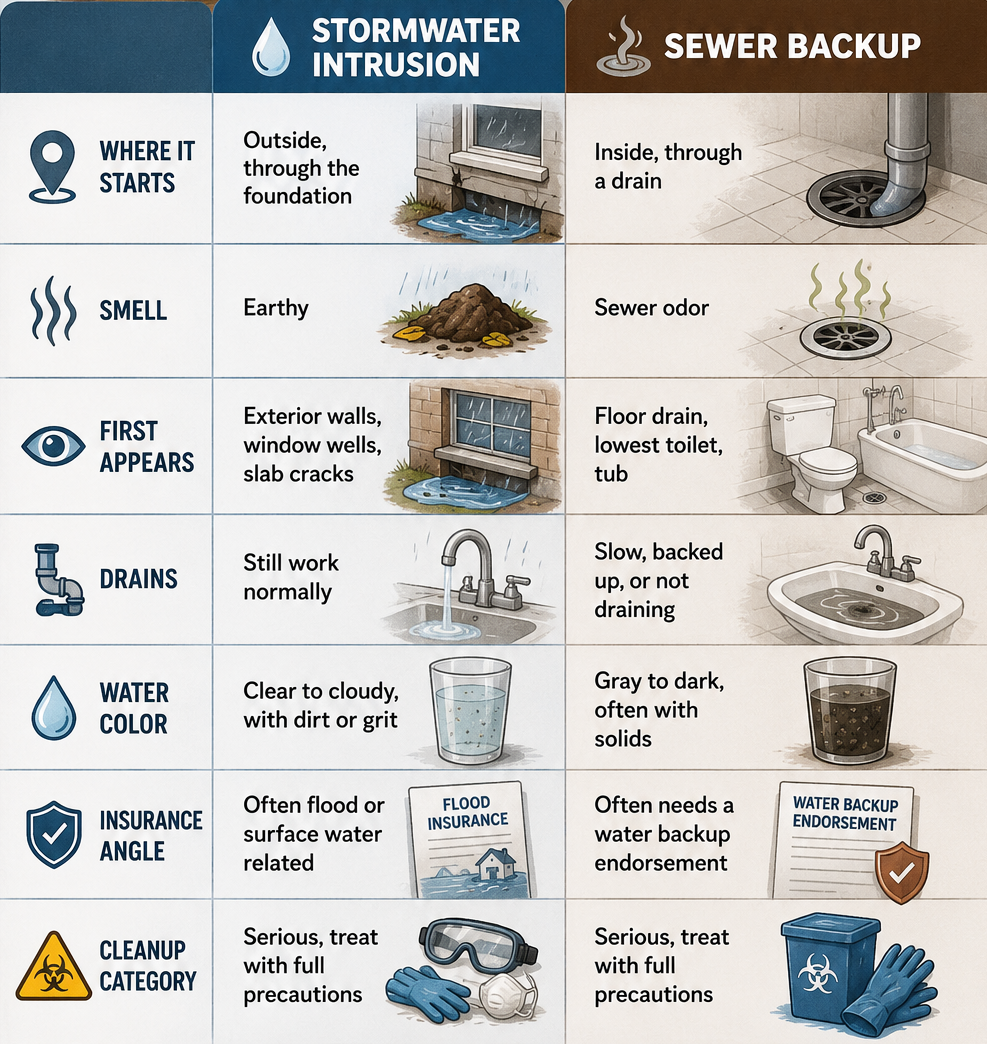
If you are ever unsure which one you are dealing with, take photos and video before you disturb anything, then call a licensed plumber or a restoration company.
Why Both Are Treated as Serious Contamination?
Restoration professionals follow an industry standard called IICRC S500, which sorts water damage into categories based on how contaminated it is. The most serious tier, Category 3, covers water that can carry disease causing organisms, toxic substances, and harmful chemicals. Sewage clearly qualifies. So does outside stormwater that has flowed across soil, since it picks up bacteria, animal waste, and chemical residue along the way.
That classification is what drives the entire safety plan. This level of contamination calls for protective equipment, stopping the water at its source, containment, removing anything porous that cannot be fully cleaned, thorough cleaning and disinfection, and carefully controlled drying.
Common Mistake. Running fans before contaminated materials are removed. Air movement is important for drying, but it needs to happen after contaminated areas are contained and cleaned, not before. Otherwise you are just blowing contaminants around your house.
How Fast Should You Act?
Quick answer. Immediately.
Microbial growth can start within a couple of days on wet materials like drywall and wood. Every hour water sits is an hour it has to soak deeper into your walls, floors, and belongings. Acting fast is not just about limiting damage. It is also about protecting your family's health and showing your insurer that you took the problem seriously from the start.
Should You Stay in the House?
If the affected area is contained to a basement or lower level and you can close it off from the rest of the home, many families do stay, as long as electrical safety has been confirmed and the area is sealed off from the living space. If water is anywhere near live outlets or appliances, stay out until power has been safely disconnected by a qualified person. If contamination is extensive or reaches multiple levels, temporary relocation may be the safer call, especially with kids, pets, or anyone with a weaker immune system in the home.
Can You Clean It Yourself?
For a very small, contained spill of clean water, maybe. For anything touching stormwater or sewage, this is a job worth handing to professionals. Both are considered serious contamination, and home remedies like mopping and running household fans can actually spread contaminants through the air and push moisture into wall cavities where mold can start growing within days. A professional team has the containment equipment and protective gear to do this safely, and their documentation also strengthens your insurance claim.
First Steps to Protect Your Health
Safety comes before saving belongings.
Keep people and pets out of the affected area. If water is anywhere near live outlets or appliances, do not enter until power has been safely disconnected. Avoid using sinks, toilets, or drains if you suspect a sewer backup, since running more water down them can make the backup worse. Close interior doors to isolate the affected level if you can. Do not run central air or heat in a way that pulls air from the affected area into the rest of the house. Take photos and short video of where the water came in, its color, and the first signs of damage on walls and belongings.
Homeowner Tip. Take photos before moving anything. Those first photos are often the most valuable evidence when you file your insurance claim.
Call a licensed plumber if you suspect a sewer backup, and call a restoration company either way. The faster contaminated water is removed and the spread of moisture is cut off, the lower your health risk and the stronger your claim.
What Professional Water Damage Cleanup Actually Looks Like
Here is what actually happens once a professional crew arrives:
Arrival and inspection
- Technicians assess the scene and confirm what type of event they are dealing with.
Moisture mapping
- Thermal cameras and moisture meters trace exactly where the water traveled, including behind walls and under flooring where you cannot see it.
Containment
- Plastic barriers go up to seal the work zone off from the rest of your home, and negative air machines with HEPA filtration keep contaminated air from drifting into clean rooms.
Extraction
- Bulk water gets pulled out with truck mounted or portable equipment. If it is a sewer backup, a plumber may temporarily cap the floor drain to stop more water from coming up while the municipal system settles.
Demolition
- Materials that cannot be reliably cleaned, like soaked carpet pad, insulation, and the lower section of drywall, get removed. Cuts are made high enough above the waterline for a clean rebuild later.
Cleaning
- This is more than wiping surfaces down. Technicians vacuum with HEPA filtration to pull up dried residue, then apply cleaning agents to break down organic material.
Disinfection
- Products appropriate for the surface get applied and left to sit for the full time listed on the label, since cutting that time short defeats the purpose.
Drying
- Air movers and dehumidifiers go to work once contaminated materials are gone and surfaces are clean, with daily moisture readings tracking progress until everything matches the dryness of unaffected parts of the home.
Verification
- Only once everything checks out dry and clean is the job considered done.
What Can Be Saved, and What Cannot?
Some things bounce back just fine. Solid wood furniture, metal shelving, dishes, and some plastics can often be cleaned and disinfected successfully. Solid wood cabinets that only got wet at the toe kick, without the wood swelling, can sometimes be saved after a careful look. Tile floors often clean up well too, though the subfloor and wall base underneath still need to be checked for hidden seepage.
Porous items are a different story. Carpet and pad, most rugs, soaked drywall and insulation, swollen baseboards, and upholstered furniture are difficult or impossible to fully sanitize once they have been exposed to this level of contamination. Mattresses and pillows should be replaced outright. Electronics that got splashed or submerged should be checked by a specialist before you try turning them back on. Trying to save something that ends up growing mold later almost always costs more in the end, both in dollars and in claim headaches.
Documenting the Damage
Your documentation is what turns a claim into a paid claim.
Take wide photos showing the overall area and water lines, then close ups of entry points, drains, and visible contamination. Keep a simple log of dates and what you observed. Ask your restoration company for moisture maps and daily readings. If they run any post cleaning verification, request the written results.
You do not usually need air sampling to prove contamination, since that is based on where the water came from and what it touched. But things like surface swab tests and detailed photo logs can strengthen your file if coverage or scope ever gets challenged. Hang onto invoices, equipment serial numbers, and a list of anything that had to be thrown out.
Will My Insurance Cover This?
It depends entirely on which type of water event you had and what your specific policy covers, so do not assume either way until you check.
Most homeowners policies cover sudden, accidental physical damage, unless a specific exclusion applies, and water damage has several of those.
Stormwater that enters from outside usually falls under a flood or surface water exclusion. Covering that typically requires a separate flood policy, though some carriers offer limited add on coverage for groundwater or foundation seepage in specific situations.
Water that backs up through a drain, or a sump pump that overflows, is often only covered if you specifically purchased a water backup endorsement. That endorsement usually has its own coverage limit and may restrict mold coverage further.
There can be helpful coverage hiding elsewhere in your policy too. Tearing out material to reach a broken plumbing component can sometimes be covered even when the component itself is not. A service line endorsement may cover damage from a broken sewer line on your property. Additional living expenses may be covered if your home is not livable during cleanup.
Common scenarios.
If water came up through your floor drain or a lowest level toilet, that is a sewer backup scenario, and a water backup endorsement is what you would look for. If water came in along the foundation wall or through a window well, that is stormwater intrusion, and flood coverage or a specific endorsement is what applies, not your standard policy.
What to say when filing a claim. Describe exactly what you observed in plain language. If it is a sewer backup, mention that water came up from the floor drain, that there was a sewer smell, and whether a plumber confirmed the municipal line was overwhelmed. If it is stormwater, describe where it entered, such as the foundation wall or a window well, and note that no water came from your interior drains or toilets.
What not to say. Do not call it a flood unless you actually carry flood insurance, since that word has a specific legal meaning and can trigger an exclusion you did not intend to invoke. Do not guess out loud about long term seepage, wear and tear, or construction defects. Stick to what you actually observed and what licensed professionals reported.
This guide is general information, not legal advice. If you run into a dispute, a public adjuster or an attorney licensed in your state can help.
Working With Your Adjuster
Invite the adjuster to inspect the property as soon as it is safe. Leave containment and equipment in place if you can, so they can see the professional response in action. Share your plumber's report, moisture maps, and photos. Walk them through where the water traveled and where it first caused damage, since that path is one of the strongest indicators of cause.
Ask the adjuster directly which part of your policy they are applying and whether any limits or exclusions affect the scope of what is covered. If mold limits come into play, make sure the Category 3 classification and the steps you took to prevent mold growth, like promptly removing porous materials and controlling drying, are documented clearly.
If Your Claim Gets Denied
If coverage is denied or limited in a way that does not match the facts, ask for that decision in writing along with the specific policy language behind it. Compare what they cited against your own documentation. If you believe the cause was misclassified, a report from a licensed plumber or an independent restoration consultant can help make your case. You can request a reinspection or file a formal appeal. A public adjuster can represent you in negotiations for a fee, and your state's insurance department will accept a complaint if you believe a claim was mishandled or unreasonably delayed.
Preventing the Next One
A little maintenance goes a long way toward avoiding both problems.
Outside, keep gutters clean and make sure downspouts discharge well away from your foundation. Regrade soil so water flows away from the house instead of toward it. Add covers to window wells and make sure their drains stay clear. A perimeter drainage system and a sump pump with battery backup are worth the investment, especially if outages tend to happen during storms.
Inside, a properly installed backwater valve on your sewer line can stop a municipal surcharge from ever reaching your home. Have a licensed plumber inspect your sewer line periodically for sags, cracks, or root intrusion. Never flush wipes or pour grease down the drain. Know exactly where your main cleanout is so a plumber can get to it fast in an emergency. Testing your sump pump and any backup systems before storm season means you find problems on your own schedule, not in the middle of a crisis.
Frequently Asked Questions
Is water from my yard really as dangerous as sewage?
- Yes, in terms of how it needs to be treated. Yard runoff picks up soil bacteria, animal waste, fertilizer, and other contaminants along the way. That is why most outside stormwater entering a home gets treated with the same level of caution as sewage, even when it looks clear.
How fast can mold grow after a water event?
- Mold can start growing within a couple of days on wet materials like drywall and wood. That is exactly why removing wet porous items quickly and drying the space properly matters, both for your health and for showing your insurer you acted to limit further damage.
Can I use household bleach to clean up after a backup?
- Household disinfectants can help on hard, non porous surfaces, but a full sewage event calls for protective equipment, removal of anything that cannot be reliably cleaned, and proper ventilation. In most cases, a professional restoration team is the safer route. Always follow product label directions and never mix chemicals together.
Will my policy cover a sewer backup?
- Often not automatically. Many policies exclude water that backs up through a drain unless you specifically purchased a water backup endorsement, which usually comes with its own limit and may restrict mold coverage. Check with your agent before storm season, not after.
What if my plumber says the city sewer caused the backup?
- Ask for that in writing, specifically stating that the municipal line was overwhelmed and that water backed up through your drain as a result. That language directly supports a water backup claim under most endorsements. Some cities have a separate claims process for documented city caused backups, but that is different from your homeowners policy.
Are roof leaks the same as stormwater intrusion?
- No. Roof leaks are a different type of event from ground level stormwater intrusion. They may be covered under your standard policy if sudden and accidental, and are often treated as a lower contamination category since the water has not touched soil or sewage. The cleanup still focuses on drying things out and preventing mold.
Should I wait for the adjuster before starting cleanup?
- No. Most policies actually require you to take reasonable steps to protect your property from further damage. Take photos and video first, then begin reasonable steps like extraction, containment, and removing anything obviously ruined. Keep every receipt and log along the way.
The Water May Be Gone. The Risks Might Not Be.
Whether the water entered through your foundation or backed up through your drains, one thing stays the same. The longer contaminated water sits, the greater the risk of structural damage, mold growth, and hidden contamination you cannot see yet.
Acting quickly is not just about drying out your basement. It is about protecting your family's health, preserving your home, and making sure your insurance claim starts on the right foot.
When in doubt, it is always better to have the damage professionally assessed than to discover weeks later that moisture was hiding somewhere you could not see.
Triad Property Recovery handles water damage restoration throughout the Dallas Fort Worth area, from the first extraction to the final walkthrough, with documentation built for your insurer along the way.